
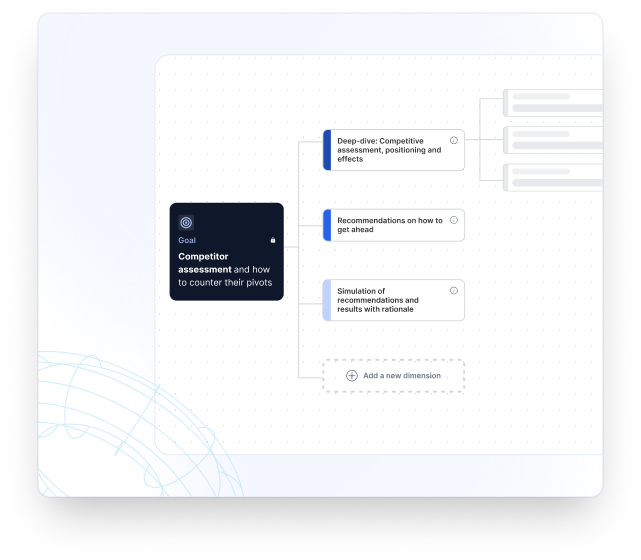
A first-pass hypothesis tree and options assessment is typically available within days of the engagement being scoped. This is specifically designed for the compressed timeline of competitive response situations where the value of the analysis decays rapidly.
Competitive response strategy: decide before the window closes.
Structure your options and act on them before the competitive moment passes.
57%
Non-US IT leaders affected
4-6 weeks
Typical response to competitor moves
80%
Intelligence not tied to decisions
Trusted by teams making high-stakes decisions











1
What decision does this use case solve?
A competitor makes a significant move: a new product launch, a pricing shift, an acquisition, a geographic expansion, or a technology announcement. The instinct is to react. The better move is to decide: does this require a response, and if so, what kind, on what timeline, and with what trade-offs?
Most enterprises react because the decision framework for a structured competitive response does not exist. The options are not laid out. The assumptions behind each response are not tested. The cost of inaction is not quantified against the cost of overreacting. The result is either paralysis or an expensive countermove that was not strategically necessary.
Entrapeer structures competitive response as a decision, not a reflex. The output is a set of defensible options with explicit trade-offs, delivered fast enough to be relevant.
2
Frame the competitive event as a strategic decision
Not every competitor move requires a response. Entrapeer begins by structuring the question: what does this move actually signal about the competitor’s strategy, how does it affect your position, and what is the cost of different response types (mirror, differentiate, ignore, accelerate)? The hypothesis tree maps from competitive event to strategic implication to response options, so the decision is grounded in strategic logic rather than anxiety.
Description of the competitor move, your current competitive position in the affected area, and your strategic priorities for the cycle in which the response needs to be considered.
3
Assess response options against market intelligence
Entrapeer surfaces the competitor’s likely strategic intent based on their broader moves, financial position, and market context. Response precedents from comparable competitive events in your industry and adjacent sectors are mapped to your specific situation. Each response option is assessed on strategic impact, resource requirement, execution risk, and reversibility, so the decision is not between “respond” and “don’t respond” but between specific, costed options with visible trade-offs.
4
What Entrapeer builds
A competitive response decision package in three layers. First, a competitive situation assessment: what the move signals, how it affects your position, and what the landscape looks like after the response options are considered. Second, a response recommendation: the preferred option with rationale, the conditions under which it should be revised, and the triggers for escalation. Third, Decision Memory: the full analysis stored so future competitive moves can be assessed against the pattern of prior responses rather than from scratch each time.
Frequently asked questions
Entrapeer works from publicly available signals, comparable precedents, and the pattern of the competitor's prior moves when direct intelligence is limited. The analysis makes the data constraints explicit, so your leadership knows which parts of the response recommendation are well-supported and which are based on inference.
Yes. The Strategic Intelligence Agent is specifically designed for continuous competitive monitoring. It tracks signals, updates the competitive picture as new information emerges, and flags when conditions change in ways that should trigger a strategic review.
Entrapeer connects to your existing intelligence sources and internal data. The value it adds is not in gathering intelligence your team does not already have, but in structuring it against the specific decision in front of you and making the trade-offs explicit.
Ready to stop
rebuilding strategy?
Share one strategic question. We'll show you the logic, the trade-offs, and the execution path yours to own and update.